

If you’re shipping goods from China, ocean freight is your bread and butter — but getting it right means more than just booking a container. The difference between a profitable shipment and a costly headache often comes down to how well you understand your options. Let’s cut through the noise.
FCL vs. LCL — Which One Actually Saves You Money?
Full Container Load (FCL) is straightforward: you fill a 20GP or 40HQ container, you pay a flat rate. The biggest myth? “I don’t have enough cargo for FCL, so I’ll do LCL.” That’s not always the smarter move.
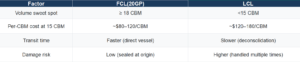
The real-world rule: Run the math on anything between 12–18 CBM. With consolidation fees (CFS charges), documentation surcharges, and longer lead times, LCL can actually cost more than FCL at that range. Don’t assume — quote both.
Hot Ports on the China–US and China–Europe Lanes
China–US

2026 tip: LA/LB congestion has eased significantly, but vessel bunching still happens during peak season (Aug–Oct). Book with a 1-week buffer and avoid shipping to Chicago via rail in Q4 — rail dwell times spike to 7–10 days.
China–Europe

Red Sea disruption is still shaking schedules in 2026. Carriers rerouting around the Cape of Good Hope have added 7–10 days to Europe-bound transit. When quoting delivery dates to your buyers, build in that extra window — even for “direct” sailings.
LCL Consolidation — The Pro Moves
LCL gets a bad rap because of hidden costs and handling damage. Here’s how to do it right:
• Consolidate at a single origin warehouse — mixing pickups from different suppliers multiplies warehouse handling fees. Have your suppliers deliver to one consolidation point in Yantian or Ningbo.
• Watch for “volume inflation” — LCL carriers often round up to the next 0.5 CBM. If your cargo is 1.1 CBM, you’ll pay for 1.5 CBM. Palletize efficiently to minimize voids.
• Use pallet straps, not shrink wrap alone — LCL containers are stripped and restacked at transshipment hubs. Straps keep your cartons from shifting during deconsolidation.
Ocean Surcharges — What You’re Actually Paying For
• BAF (Bunker Adjustment Factor) — floating fuel cost, varies monthly. In 2026, expect $400–800 per TEU depending on the lane.
• GRI (General Rate Increase) — carriers announce GRIs on the 1st and 15th of each month. Book after a GRI announcement, not before — rates often soften after the initial spike.
• PSS (Peak Season Surcharge) — kicks in July–October. Pre-book Q4 volumes by June 30 to secure lower rates.
• ERS (Equipment Repositioning Surcharge) — applies when demand is unbalanced back-to-front on a route.
Pro tip: Ask your freight forwarder for a “total landed cost” breakdown before you confirm the booking. A forwarder worth their salt should show you the all-in number, not just the base ocean rate.
Practical Takeaway
The single most impactful move you can make this year: run FCL vs. LCL comparison quotes at the 12–18 CBM range, build a 2-week buffer into Europe-bound schedules to account for Red Sea rerouting, and ask for all-in pricing — including BAF, ERS, and CFS charges — before you book. Freight is never just the rate on the quote sheet.
Need a specific lane analyzed? Talk to the Vinia Cargo team — we handle ocean freight across all major China-to-world routes daily.