

If you’re shipping internationally, ocean freight is likely your backbone — moving roughly 90% of global trade by volume. But the difference between a profitable shipment and a costly headache often comes down to the details. Here’s a practical breakdown of what every logistics manager should know.
FCL vs LCL: Which One Actually Saves You Money?
The FCL-vs-LCL decision isn’t just about volume — it’s about unit economics.
Full Container Load (FCL) typically costs 200–800 more per container than the equivalent LCL space for a 20GP (about 28 CBM usable), but the per-unit cost plummets once you fill about 12–15 CBM. The rule of thumb: if your cargo occupies more than 8–10 CBM, quote both FCL and LCL — you’ll often be surprised that FCL comes out cheaper or only marginally more, while giving you exclusive use of the container.
Less than Container Load (LCL) shines when you’re below 8 CBM, but watch for:
• Consolidation fees ( 15–50 per CBM at origin)
• Deconsolidation fees at destination
• Cargo handling charges — some carriers charge per “bill of lading” + per CBM
• Transit time: LCL adds 3–7 days on most routes due to consolidation/deconsolidation at hub ports
When LCL can backfire: Fragile goods, high-value products, or shipments needing tight temperature control — shared container space means shared risk.
Hot Ports on the China–US and China–Europe Lanes
Trans-Pacific (China → US West Coast)
• Origin: Shanghai (SHA), Shenzhen/Yantian (YTN), Ningbo (NGB), Qingdao (TAO)
• Destination: Los Angeles/Long Beach (LAX/LGB) — dominant gateway for 60%+ of US imports
• Alt: Seattle, Oakland, Savannah (for inland rail connections)
China → Europe
• Origin: Same Chinese mega-ports
• Destination: Rotterdam (NL), Hamburg (DE), Antwerp (BE), Felixstowe (UK)
• The “Northern Range” ports offer faster rail/truck connections to inland EU
Consolidation Tactics (LCL Pro Tips)
1. Match cargo by destination geography — don’t mix Swiss-bound cargo with Romanian-bound cargo in the same consolidation unless it clears the same gateway
2. Use a co-loader when your volume is just below the next container bracket — they can top off your FCL with compatible cargo and split the cost
3. Palletize early — loose cargo in LCL containers is more likely to shift and incur damage claims
4. Ask about “FCL on LCL terms” — some forwarders offer this hybrid: your cargo gets exclusive container space but you pay per CBM, ideal for 12–18 CBM shipments
Schedule Planning: The 80/20 Rule
Booking ocean freight 3–4 weeks ahead is standard, but here’s what many miss:
• Peak season surcharges (PSS) typically hit in August–October for Trans-Pacific — book by June/July if possible
• Blank sailings (carrier cancellations) spike in Chinese New Year (Jan–Feb) and Golden Week (Oct) — plan inventory buffers
• Best days to book: Mid-week bookings (Tue–Thu) often clear customs faster on the origin side than Monday rushes
Ocean Freight Surcharges — The Hidden Cost Layer
Base ocean freight is only 60–70% of your total bill. Here’s what else hits your invoice:
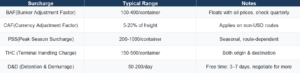
Pro tip: Ask your freight forwarder for an “all-in” quote including these surcharges, not just ocean freight. The 20GP base rate of 1,200 can easily become2,400+ after surcharges.
Bottom Line
Ocean freight isn’t just about moving cargo — it’s about designing the right container strategy, timing, and surcharge awareness. Get these three things right, and you’ll consistently ship below market rates with fewer delays.
For importers and exporters on the China–US or China–Europe lanes, the difference between a 32-day transit and a 38-day transit often comes down not to the carrier you choose, but to how you manage consolidation, booking timing, and documentation readiness. Fix those, and the schedule fixes itself.
Viniacargo — your logistics partner for smarter ocean freight.